Trump launches AI-fueled America.gov in bid to tie government services together
The Trump administration unveiled an artificial intelligence chatbot Tuesday that it views as a new front door for services from the federal government.
America.gov, which launched Tuesday morning, opens with a search bar inviting users to ask anything — from booking a campsite at a national park, to getting a passport for their child, to replacing their Social Security card. “Whatever you need from the government, start here,” the homepage says.
“Under the hood, America.gov is an extraordinary use of AI designed to improve your life. It’s trained specifically on one official source of truth: The United States Government,” Joe Gebbia, the U.S. Chief Design Officer and co-founder of Airbnb, said during the launch event in Washington, D.C.
According to remarks Gebbia made to CNBC’s Squawk Box on Tuesday, the platform is powered by Google’s Gemini and Elon Musk’s Grok.
The initiative comes as the Trump administration has, generally, sought to increase the use of AI in government and decrease restrictions on the technology. While the government was already implementing the technology before the current Trump administration, AI use has swelled over the past several years.
Programs like the General Services Administration’s OneGov initiative provide AI services to agencies at almost no cost, while programs like USAi provide access to a variety of models at once. America.gov is seemingly its most ambitious move to infuse AI in the government yet.
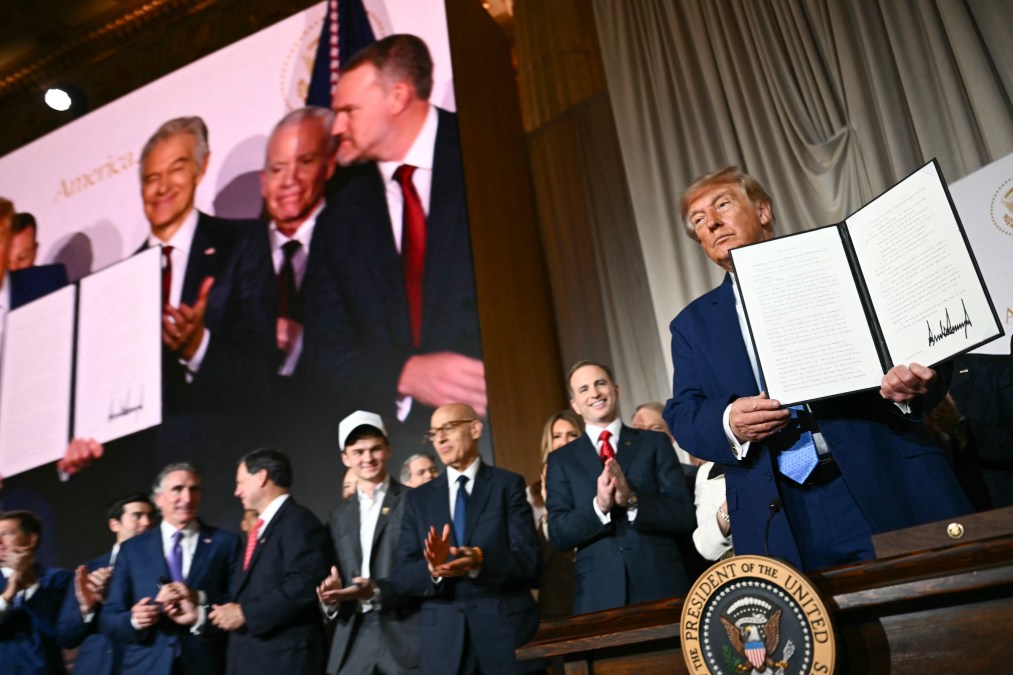
Instead of searching through thousands of government websites, “you’ll now have one front door for every single question,” President Donald Trump said in remarks at the launch event.
According to Trump, the project started “almost on day one” of his administration. He thanked Gebbia, Chief Brand Architect of the U.S. Peter Arnell, and Edward Coristine, the DOGE member known by the name “Big Balls,” for their work on the project. Per Trump, Coristine is the lead engineer for America.gov.
Notably, Trump also thanked Musk, who founded Trump’s controversial DOGE but left before the group saw the end of its mandate. Trump credited Musk with being the person who “initially envisioned the transformation of government through technology and brought us the talent to get the job done.”
Trump signed an executive order on the establishment of America.gov during the event.
Specifically, that order directed the head of the General Services Administration, the National Design Studio, and the Office of Management and Budget director to establish the platform as “the single point of entry for Americans to access covered services online,” while also directing them to integrate Login.gov.
That followed the administration’s recent direction for agencies to start using Login as an identity verification option wherever possible.
Large-scale launch
The event, dubbed “Hello, America,” was hosted by the National Design Studio and held in the Andrew W. Mellon Auditorium, just blocks from the White House. A host of Cabinet officials were also in attendance, including Defense Secretary Pete Hegseth and Commerce Secretary Howard Lutnick.
In addition to Gebbia, former White House press secretary Karoline Leavitt and motivational speaker and author Tony Robbins gave introductory remarks, and Centers for Medicare and Medicaid Services Administrator Dr. Mehmet Oz and Secretary of State Marco Rubio gave demos.
The event also had several panels featuring government officials and tech leaders from companies like Meta and Palantir. One of those panels even included Musk, Nvidia CEO Jensen Huang and Anthropic co-founder Tom Brown.
Those leaders were among the AI industry executives that met with Trump at the White House also on Tuesday and signed an agreement with respect to development of the technology that the president called “morally binding,” per the White House pool report.
“We agreed to a number of things that include joint-monitoring, boards, special committees, and just generally grading each others’ homework, which is a lot better than if people just grade their own homework — for obvious reasons,” Musk said of that agreement during the panel.
In addition to America.gov’s launch, Trump also doubled down on his plans to start calling AI “Super Intelligence.” A second executive order Tuesday declared that the executive branch will start using the new term and its abbreviation “SI” in place of AI where possible.
That change already slipped into remarks Tuesday from industry and officials, who often used AI and super intelligence interchangeably.
On the site
According to America.gov, the platform is bringing together information from roughly 29,000 government websites. Per Gebbia, updates to government websites will be accessible to the America.gov platform immediately.
The version launched Tuesday, however, isn’t the final product.
Currently, the chatbot allows users to ask questions and receive directions on where government services are located, but Gebbia said there are plans come 2027 to allow users to continue processes on the platform itself and track progress.
He gave an example in which a user changing their name after marriage would be able to submit their documents without leaving the platform. In that demonstration, the “Hello, America” welcome message changed to “Hello” followed by the user’s name.
While Gebbia said that the website is “private by design,” there are still unknowns with the new tool. It wasn’t immediately clear how the AI underpinning the platform was procured and how those tools will protect user privacy.
A privacy notice above the chat reminds users to “share only what’s needed,” discloses that it may use approximate location, and states that its “AI providers do not retain your prompts or responses.”
“America.gov may cache responses for up to two hours, using a hash of the prompt rather than storing the prompt text,” that notice continues.
The White House didn’t provide responses to FedScoop’s questions with further detail on how it protects privacy and information about the agreements or contracts pertaining to the technologies it leverages. GSA and xAI also didn’t respond to requests for comment for more details about the agreements for use of the AI tools.
Google similarly didn’t respond to questions on cost and what the arrangement looks like, but Google Public Sector Vice President of Federal Jim Kelly did comment on its involvement in the new platform.
“Google is proud to be named a technology partner in this vital initiative, leveraging Gemini to help more than 100 million people access critical public resources with greater speed and ease,” Kelly said in a statement. “By supporting the administration’s vision for digital modernization, we are committed to making these everyday public services seamless, accessible, and responsive for all Americans.”
More to come
Public sector technologists, meanwhile, underscored that there’s still work to come on a project like this.
Mikey Dickerson, the founding administrator of the U.S. Digital Service, told FedScoop that the next steps for America.gov — in which the administration envisions the ability for users to complete a variety of tasks without ever leaving the platform — is the tricky part.
“It’s very easy to get something very superficial done, and that’s why it’s been done several times before,” Dickerson said, pointing to USA.gov and Benefits.gov. But beyond that, “it becomes impossible, or at best very difficult, to get any farther than the superficial collection of links,” he said.
In his experience, Dickerson said the issues blocking the ability to move beyond links alone for a tool like America.gov include the fragmented nature of government program ownership, program details, and technical obstacles like mismatched definitions. For example, he said, the definition of income for tax filing and applying for Medicaid are different.
Dickerson said if the Trump administration can make its aspirations for expanding the platform a reality, that would “be a great service” — but what was released Tuesday isn’t there yet.
“You announced a demo which solved like the easiest 5% of the problem, and I’m not going to get impressed until you solve some of the actual hard parts,” Dickerson said.
Code for America CEO Amanda Renteria similarly said the mission of making the government easier to navigate is something the country can and should pursue. But getting that right involves starting with the people at the center and selecting the technology best suited to solve the problem.
“We’ve been down this path before: a new website, tool, or platform that promises to transform government,” Renteria said in an emailed statement. “But the measure of success isn’t whether government has adopted a new technology. The true measure is that technology’s impact on people often experiencing one of the hardest moments of their lives.”
This story was updated on Sept. 29 with additional reporting throughout, including information about Trump’s super intelligence executive order and comments from Musk, Kelly, Dickerson and Code for America.