DHS begins $1.5B spending spree on drone defense
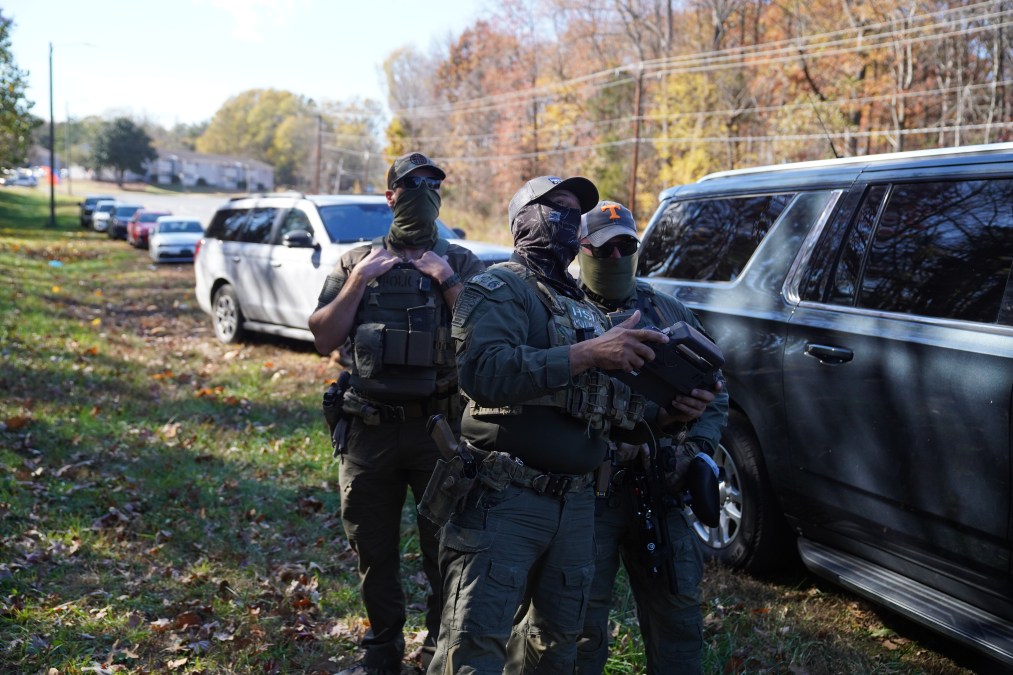
The Department of Homeland Security is putting up to $1.5 billion toward bridging its drone defense gaps with awards going to Anduril, Booz Allen, GDIT and others, per procurement documents posted Friday.
The sought-after contract had 47 vendors vying for a slice of the massive award. DHS separated awards into two categories for the indefinite delivery, indefinite quantity procurement plan.
Track one houses seven hardware, software and ancillary service providers, such as Fortem, D-Fend and CACI. Another seven vendors providing “comprehensive services” for counter-UAS are under track two, including Anduril, Booz Allen and GDIT. The only two tech companies in both tracks are Leidos and BAE Systems.
DHS expects to spend more on the hardware and software group, which has an estimated ceiling of just over $1 billion. Track one contractors will provide the physical components and software for DHS to test and operate, as well as the necessary training, maintenance, installation, customization and support for the counter-UAS tools.
The group providing comprehensive services has a ceiling of less than $500 million. Track two contractors will provide system integration to ensure interoperability, execute research and development activities and provide counter-UAS capabilities as a “fully managed service,” according to DHS procurement documents.
A start date was set for the beginning of August and will wrap up in 2031. OrangeSlices first reported the contract awards.
DHS wants to add drone defenses that can detect a UAS at a minimum range of 2 km, track a minimum of three UAS simultaneously and mitigate UAS threats at a minimum range of 500 meters, according to its statement of work and solicitation documents.
The chosen contractors will be responsible for providing detailed testing reports to validate system performance. Vendors will also need to provide training for DHS components that covers system setup, operation and maintenance. The group of tech providers will meet with DHS in the coming weeks to get on the same page and chart a path forward.
For DHS, the influx of counter-UAS capabilities couldn’t come quicker.
The agency has repeatedly said it grapples with lagging drone defense skills. During a congressional hearing in June, for example, DHS Secretary Markwayne Mullin said the agency has put a “tremendous amount of ability and money” into offensive drone capabilities, but its counter-drone defense needs improvement.
Top officials echoed the sentiment during a Commercial Drone Alliance event last week.
“We’re behind the hook,” Pedro Allende, under secretary for science and technology at DHS, said during the event. “Everything from layered defenses and arrest jamming to take-over to kinetic, nothing’s off the table.”
One hindrance to improved counter-drone defense is the length of typical federal contracting, according to Allende.
DHS is eyeing a workaround, such as an acquisition tool like Other Transactions Authority. In the past, DHS has used the lever to work with non-traditional contractors that “would otherwise not do business with the Federal Government,” per the inspector general office.
OTAs are not subject to Federal Acquisition Regulation, increasing flexibility while also potentially decreasing accountability and transparency.
“I’m working really hard to get OTA for DHS S&T, which will allow us to move much more quickly,” Allende said.
While the House passed a bill to extend DHS’s ability to use OTAs into fiscal 2027, it didn’t go any further. The Homeland Security Act of 2002, which gave the initial go-ahead, carried an OTA expiration date of 2024.
To Allende’s point of grievance with the existing procurement process, the agency was delayed in awarding its latest IDIQ contract for counter-UAS. In a response to a solicitation question in November, DHS said it had expected IDIQ start dates to begin in December, around eight months before they actually did. The agency, however, was operating under a funding lapse for much of that time.
The desire to speed up procurement comes as the agency sharpens its focus on drones.
DHS created a new office dedicated to UAS at the beginning of the year, aiming to ease acquisition and deployment. The agency tabbed millions of dollars to boost drone-tracking infrastructure and detection technologies across the country.
Another round of $250 million is scheduled to go out in fiscal 2027, as appropriated by the One Big Beautiful Bill Act. The funds will go toward bolstering drone detection and mitigation capacity at the state and local level, but there are questions as the anticipated award date grows closer.
“To date, there is no strategic plan that gives us a sense of prioritization,” said Charles Werner, director of nonprofit DroneResponders. “If the states are going to manage this, the states are going to need to know what the federal government is looking for.”
“We’re going to have all this money,” Werner added. “How do we make it all work together?”