Records show White House, DOGE involvement in National Science Foundation grant terminations

A set of federal Freedom of Information Act records reveal new details about the level of White House and Department of Government Efficiency involvement in grants terminations at the National Science Foundation.
The two sets of documents were obtained by Democracy Forward, which has frequently challenged the Trump administration in federal court, and provide NSF communications involving DOGE affiliate Zachary Terrell from April and May of 2025.
That correspondence suggests Terrell recommended terminating grants from congressionally mandated programs, used a list of grants provided by the Florida governor’s office, and, notably, indicated that the White House had provided a list of grants to cut.
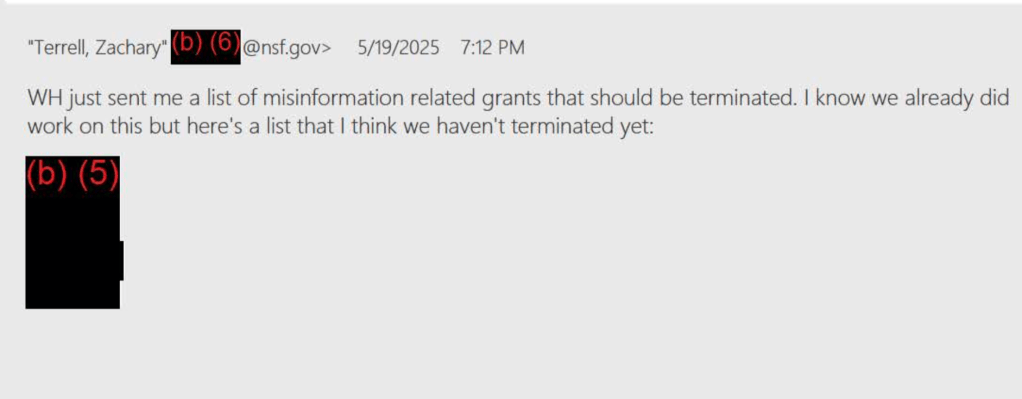
“WH just sent me a list of misinformation related grants that should be terminated,” Terrell, using a common abbreviation for “White House,” wrote in a message sent May 19, 2025. “I know we already did work on this but here’s a list that I think we haven’t terminated yet.”
It’s not clear who the recipient was, but the message was sent through an account associated with Terrell’s NSF email. The list that followed his message was redacted.
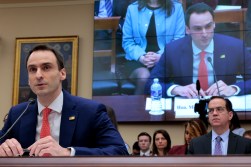
While DOGE’s presence at NSF and role in grant terminations was generally known, questions remained about the details of that involvement as well as the role of the White House in the science agency’s operations. Whether the White House was involved in NSF operations was a question Democrats on the House Committee on Science, Space, and Technology grilled Trump’s top science advisor, Michael Kratsios, on during a hearing in July.
In response to a question from Rep. Zoe Lofgren, D-Calif., the committee’s ranking member, about White House involvement, Kratsios denied that influence. “The White House is not involved in which proposals get funding at National Science Foundation,” said Kratsios, who leads the Office of Science and Technology Policy.
White House role
For advocates and lawmakers, the new records provide confirmation of that involvement.
“The National Science Foundation records confirm that the White House played a role in determining which taxpayer-funded grants to cut at NSF,” Dan McGrath, Democracy Forward’s special counsel for oversight, said in an emailed statement. “This appears to contradict White House official Michael Kratsios’ attempts to downplay the White House’s role in NSF grant decisions in his recent testimony to Congress.”
Rep. George Whitesides, D-Calif., who questioned Kratsios about OSTP’s involvement in grants decisions at the same hearing, told FedScoop that the communications show Kratsios “tried to mislead Congress, if not outright lie to us.”
“These documents point to direct White House involvement in individual grants, which is exactly what Kratsios said was not happening,” Whitesides said in an email.
In response to questions from FedScoop, the White House denied that the documents contradicted what Kratsios said. “Clearly, Director Kratsios is speaking on behalf of OSTP, the agency he represents before Congress,” a spokesperson told FedScoop in an email.
That spokesperson also defended DOGE’s involvement at NSF, stating that following President Donald Trump’s executive order on eliminating diversity, equity and inclusion from the federal government, “DOGE provided agencies guidance on retrospective, one-time grants in alignment with the EO.”
NSF declined to comment. Terrell also didn’t respond to an attempt to reach him directly.
‘Congressionally mandated programs’
While the documents include communications from a variety of individuals at NSF, including outgoing Chief of Staff Brian Stone, they mostly center on communications from or about Terrell.
Terrell is currently at the Department of Health and Human Services, where he is a special advisor to the chief information officer, and previously served as the agency’s chief technology officer.
His affiliation with DOGE has been documented in public records. According to a September 2025 court filing by the government, Terrell was a part of the health department’s “DOGE Team,” though he wasn’t an employee of the U.S. DOGE Service directly. In a May 2025 article for Time Magazine about her decision to resign her position on the NSF’s National Science Board, Alondra Nelson referred to Terrell as a member of the DOGE team who watched nonpublic board deliberations via video conference.
Terrell was among a team of DOGE affiliates who landed at NSF around April 2025. That list also included Luke Farritor, a former SpaceX intern, and Rachel Riley, a former McKinsey consultant. Of that group, Farritor and Terrell were both listed in an agency directory as consultants.
The documents appear to show some of their early activity at the agency.
On April 16, Stone sent former Chief Operating Officer Karen Marrongelle an email titled “BP Annex to DOGE.” That message is entirely redacted, but in Marrongelle’s response she asked Stone to send “the list of awards that Zach and Luke” had identified to her and “Jason B.” She stated: “We need to ensure they are on the termination list.”
Stone responded with a list, adding: “These are the awards that Zach and Luke identified when they came on day 1.”
About a week later, on April 22, former NSF official Jamie French asked Stone and Jason Bossie, office head in NSF’s Office of Award Management, if “DOGE wants to terminate this award today. OK if I proceed?” with an attached spreadsheet titled “Terminate.xlsx.”
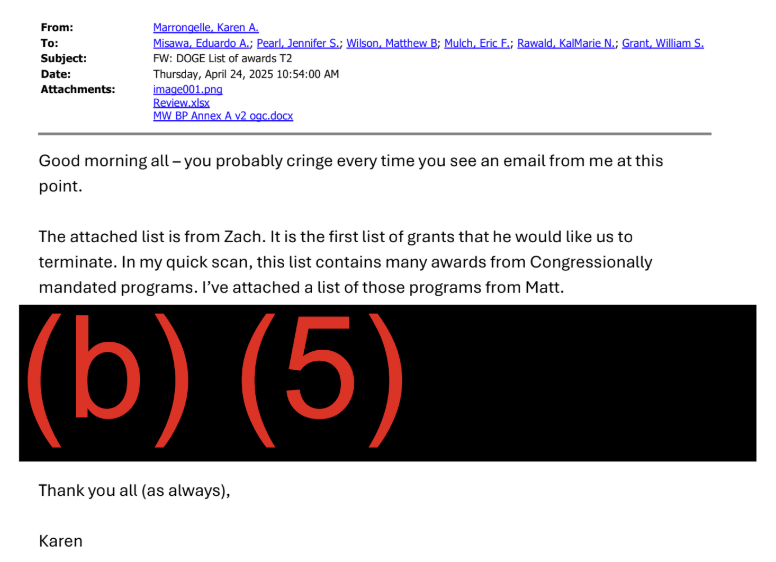
On April 23, Stone again emailed Marrongelle a list of awards from “Zach.” Marrongelle forwarded that on to a broader group the following day, stating: “This attached list is from Zach. It is the first list of grants that he would like us to terminate. In my quick scan, this list contains many awards from Congressionally mandated programs.”
Another communication from April 23 shows Bossie telling a fellow NSF official that he had received a file from “our DOGE rep” who had “identified 500 awards.” Bossie stated that he and colleagues were looking to see if there was overlap with 406 terminations already issued or a list of 782 that was being reviewed by “OD.”
That email was accompanied by an attachment titled “Zach Review File Apr 23 2025.xlsx.”
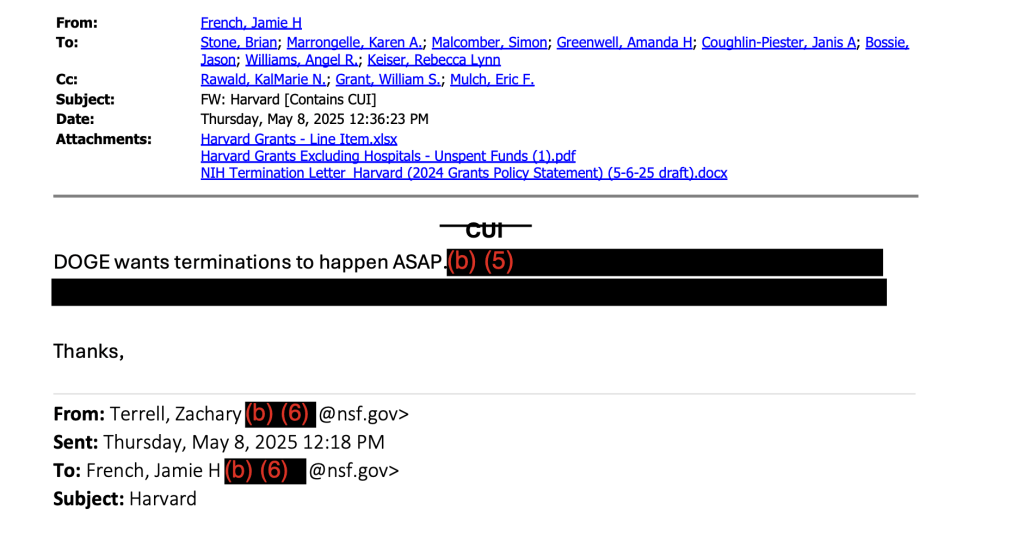
In May 2025, Terrell emailed French an email titled “Harvard,” attaching several files related to grants for the university and a National Institutes of Health termination letter. The context of Terrell’s email is unclear, but in forwarding to a larger group, French added the comment “DOGE wants terminations to happen ASAP.”
Florida involvement
The documents also show an exchange with an official from the Florida governor’s office that appeared to impact grants decisions at NSF.
On May 16, Eric Soskin, a senior advisor to the Florida governor, emailed an unknown individual at the Department of Homeland Security with “the first of several tables of grants we will be sending.”
That message was forwarded to Terrell’s HHS email and then his NSF email before he eventually forwarded it on to French on May 29. “Here’s a few more DEI grants that Florida found. Let me know if any of these are still active and let’s cancel,” Terrell said.
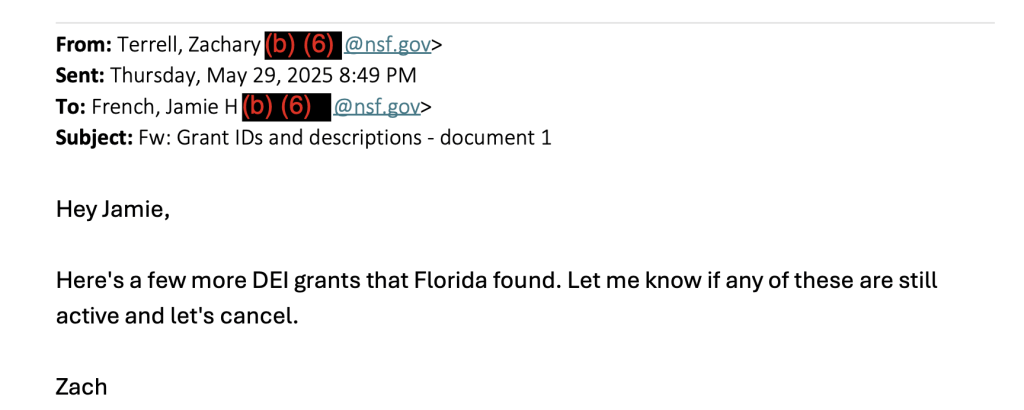
The following day, French passed that along to NSF employee Kim Bub, asking whether they could run the awards against the agency’s terminated lists. Bub replied that two of the 12 NSF awards on the list were not terminated. An attachment on that exchange is titled “Copy of USF DEI Grants (1).xlsx.”
The Florida governor’s office did not respond to FedScoop’s request for comment about Soskin’s methodology and whether he corresponded with federal officials on other grant terminations. The White House also did not address FedScoop’s questions about whether it had solicited that input and how it had applied suggestions from third parties in grants decisions.