House Democrats plot to make Trump’s science cuts ‘more difficult’
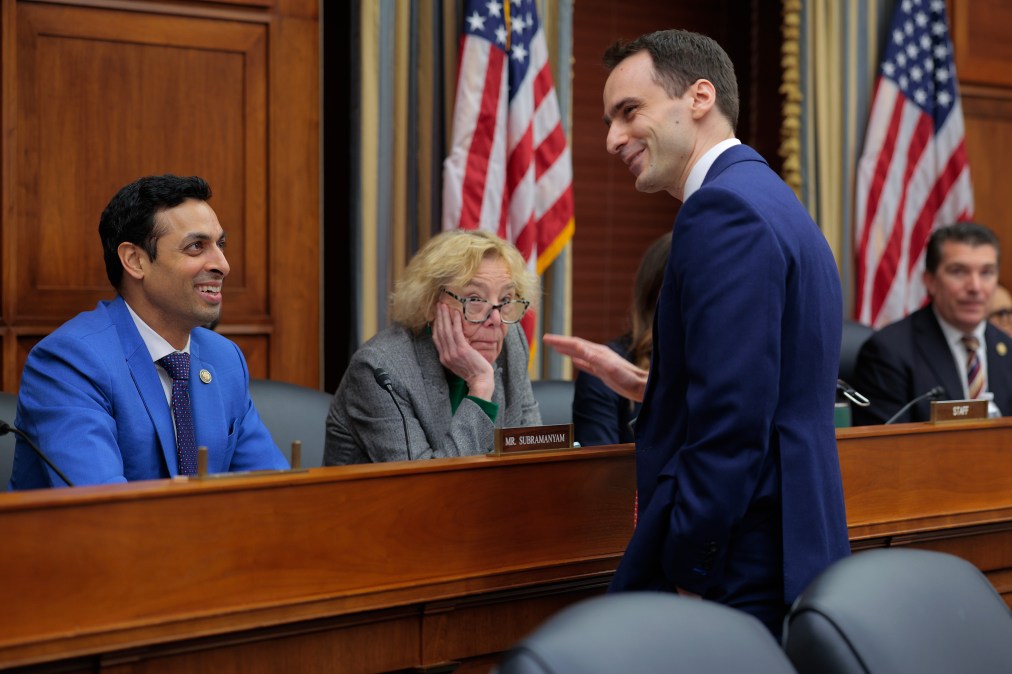
The incoming Democratic majority on the House Committee on Science, Space, and Technology is preparing to wield its new power to conduct oversight of President Donald Trump’s cuts and reshuffling within the federal science and research enterprise.
“We’re going to do oversight, and we’re going to take a look at how we can structure legislation in ways that make it more difficult for the Trump administration to continue to do this damage,” said Rep. Zoe Lofgren, who is now poised to lead the committee
In an interview this summer and recent emailed responses following the Democratic sweep in the midterm elections, Lofgren told FedScoop the panel is preparing to dive deeper into controversial Trump administration policies such as to grant cuts at the Department of Energy that targeted blue states, apparent impoundment of funds at the National Science Foundation, an Environmental Protection Agency reorganization that replaced its research office, and political appointees making grant award decisions.
The administration’s actions give the committee — which has oversight of almost the entire federal research enterprise — “a lot to cover,” Lofgren said.
While the list of oversight priorities for Democrats may be long, Lofgren and colleagues also have some optimism about legislation in areas that have traditionally had more bipartisan buy-in. Specifically, Lofgren said her priorities will be quantum, fusion, and artificial intelligence.
The House science panel has broad oversight of federal research and science agencies, making it an unavoidable venue for major science and technology legislation. Over the past decade, that’s included bills such as the National Quantum Initiative Act, the CHIPS and Science Act, and the Weather Act Reauthorization.
Politicization within AI might make legislation in that space “tricker,” but the 31-year House veteran said “all three — and certainly fusion and quantum — have always had a bipartisan effort in the House and in the committee.”
While Lofgren has previously chaired other House panels, including committees on administration and ethics, the coming Congress would be the first time taking the gavel on the chamber’s science panel. The California congresswoman, whose district includes part of Silicon Valley, has led the Democrats on the committee as the ranking member since 2023.
When asked about what the committee might start with, Lofgren said everything she’d pointed to was on the table.
“I will stop at nothing to earn back the trust of our allies across the globe, end the brain drain, restore scientific integrity across our agencies, and reaffirm our leadership in science,” Lofgren said.
‘More prescriptive’
Notably, committee Democrats identified legislation as a possible mechanism for holding the current administration in check.
As the second Trump administration has sought to alter what the federal government spends its money on, science funding has been among the targets. Science grants and programs were subject to termination as the administration sought to purge activities related to diversity, equity and inclusion and climate research from the federal government.
Despite Congress mostly rejecting Trump’s deep proposed cuts to science agencies during the last appropriations cycle, the administration has continued to push for significant reductions and, according to analysis by advocates like Grant Witness, appears to be withholding science funds at multiple agencies.
As a result, Lofgren said the committee will be closely looking into legislative levers to prevent the Trump administration’s actions, such as language that’s “more prescriptive on how money is spent,” she said.
“When you have agencies withholding money that Congress instructed them to spend so that they can move it around for their own pet projects, we have to come up with ways to get in front of that sort of blatant corruption so it cannot happen again,” Lofgren said.
In an interview speculating about a Democratic-led committee this summer, Rep. Deborah Ross, D-N.C., similarly told FedScoop that a priority would be taking back Congress’s funding authority for science and research by directing how things are done at agencies.
“We are going to have to be much more prescriptive with this administration and give them much less discretion about what to do,” Ross said.
A spokesperson for the current committee chair, Rep. Brian Babin, R-Texas, didn’t respond to FedScoop’s requests for comment on strategy or priorities under a Democratic-led panel.
‘Hatchet’ to science
In terms of oversight, Lofgren pointed broadly to the impact Trump has had on the science and research ecosystem as a focus.
“The Trump administration has taken a real hatchet to the science enterprise in this country,” Lofgren said. “They have illegally defunded research that has been directed by law … in doing so, they have done huge damage to science research and all endeavors. Not only the product of the research, but the pipeline of scientists.”
Lofgren said she’s spoken to multiple university leaders about their inability to admit doctoral students and postdoctoral students because they lack the resources to pay for the research. Moreover, she said, policies targeting international students threaten the pipeline of innovators who are Americans by choice.
When asked about priorities for a Democratic-controlled panel this summer, committee member Rep. George Whitesides, D-Calif., similarly pointed to the need to show the impact of the administration’s choices.
“I think it’s important that the American people understand the grievous harm that is being done to the American research establishment during this administration, and that harm will be felt for decades,” said Whitesides, former NASA chief of staff who was the first CEO of Virgin Galactic.
People won’t immediately see the impact of the discoveries that would have been made as a result of that funding, but Whitesides said the United States will be lacking, particularly in comparison to international competitors. The administration’s policies, for example, have caused researchers to leave the U.S. for Europe and China, he noted.
In September, Grant Witness and States United Democracy Center launched a tool that estimated $177 billion in federal dollars has been disrupted under the second Trump administration. Those organizations, which used public records to analyze impacted federal funding, concluded that Texas had lost the most federal funding of any state and Vermont lost the most per resident.
Also on Lofgren’s radar for oversight: The Trump administration’s push to gain equity stakes in private industry. That includes equity in quantum business and, more recently, stakes in semiconductor supply chain companies. Per a Cato Institute tracker, the Trump administration has made roughly 40 such investments.
“I have deep concerns about the government’s growing ownership interest in industry, and it is only compounded by the fact that these seem to be concentrated in certain industries,” Lofgren said.
Such a mechanism has only been used in emergency situations in the past and shouldn’t be part of regular business with the government, she said. Lofgren likened the activity of seizing “control of the means of production” to communism and noted that there’s irony given Trump’s frequent comments calling political opponents communists.
“We’re going to have some oversight over that and the impact on the science enterprise,” she said.
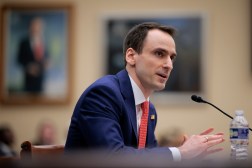
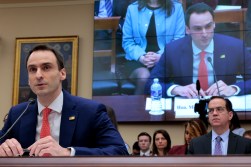
Some of the possible focuses for Democrats were previewed at a hearing just before the August recess featuring Trump’s top science and tech advisor, Michael Kratsios.
The committee members pressed the White House Office of Science and Technology Policy director on various research and science policies, including White House activity in grants decisions at NSF and the agency’s apparent withholding of funds.
Since then, public records obtained by Democracy Forward and shared with FedScoop provided new insight into activities at the agency and, for some, called into question the veracity of Kratsios’ testimony denying White House involvement.
Legislative priorities
Lofgren’s legislative priorities align with work the committee has already been conducting over the past couple of Congresses, and there’s still a chance legislation that’s already approved by the panel could win passage before the end of the current session. That includes key quantum legislation and multiple AI-related bills.
“We’re still working to get them finished this year, but if not, we would hope to move them next year,” Lofgren said of the legislation.
With respect to AI, the committee has advanced a number of bills in the current Congress — including the CREATE AI Act (H.R. 2385), which would formally establish an AI research resource at NSF, and the AI Security and Innovation Act (H.R. 9363), which would codify the AI standards body within the National Institute of Standards and Technology.
On quantum, the committee has approved the National Quantum Initiative Reauthorization (H.R. 8462), which would re-up legislation that established the national strategy for quantum research and development.
Fusion, meanwhile, is beginning to get more attention from the panel, with Lofgren and committee member Rep. Jay Obernolte, R-Calif., recently introducing the American Leadership in Fusion Act (H.R. 10574) to advance the energy technology as a source of power that’s free of greenhouse gasses. That bill includes millions in funding for NSF and DOE for fusion work. Lofgren said she intends “to move on that quickly.”
The bill’s Republican co-sponsor is also looking for movement and questioned the Trump administration about its support.
In July, Obernolte asked Kratsios about the absence of funding for fusion in Trump’s fiscal 2027 budget request when AI and quantum each received ample support. The OSTP leader said fusion was a priority, citing a goal to be able to demonstrate commercial fusion power by the mid-2030s. Obernolte pointed to the need to work with Congress.
“It’s going to require a partnership between Congress and the administration to get that funded, and commercialization is an important part of that strategy,” Obernolte said.
AI variables
Of her three focus areas, Lofgren identified AI as potentially the more difficult to reach agreement on given the divide between Democrats, who are generally pro-regulation, and Republicans, who worry that regulation stifles innovation.
But she said the committee “can regulate and innovate at the same time, just as we always have.”
At the same time, there’s also interest in centralizing the chamber’s AI work under a single committee, which could change each panel’s share of issues involving the technology.
According to reporting from Politico in September, Democratic leaders in the House are weighing an AI select committee. That effort is reportedly being led by Reps. Bill Foster of Illinois and Ted Lieu of California, and if advanced, may require some committee leaders to give up jurisdiction of AI issues.
Foster spoke to FedScoop about why the House should create a committee to deal with AI this summer.
The particle physicist-turned-congressman noted that Obernolte, who co-chaired the temporary House Task Force on AI in 2024, had tried to make the case for turning that group into a select committee but ran into seven committee chairs who all wanted their panel to be doing AI. A full standing committee, he noted, is what most other countries have.
“We got to get past this,” Foster said. “And frankly, if you’re interested in whether the Democrats are going to be doing something serious about AI, look to see if they’re willing to put in place in Congress an organization capable of dealing with it.”