DHS looks to improve tech, counter-UAS ahead of 2028 Olympics
The Department of Homeland Security has its sights set on securing the 2028 Olympics in Los Angeles.
The games will bring in more than 15,000 athletes and countless fans. While most of the games will be held in California, the torch relay spans all 50 U.S. states, resulting in a wide expanse that will need security.
The planning started just after the FIFA World Cup concluded, and with it a mountain of lessons learned. Officials across the agency have highlighted success with state and local partnerships, drone mitigation and command center hubs. But the agency doesn’t just want to rest on its laurels.
“We’re already all working together to make sure that LA ‘28 is secure,” Amy Szestak, special agent in charge of the Secret Service’s Office of Administration, said on a panel during a GDIT Emerge event Thursday. “The relationships are in place to have those conversations, whether it’s resourcing or just, ‘how would you do this,’ or ‘how would you handle this from a large event perspective?’”
Officials are also asking who was missing from the table during the World Cup and how consequence management plans should be altered.
“We have to make sure that we have the plans in place and the communications in place so that we’re able to talk to everybody,” Szestak said. “That’s one of the biggest lessons that we took away.”
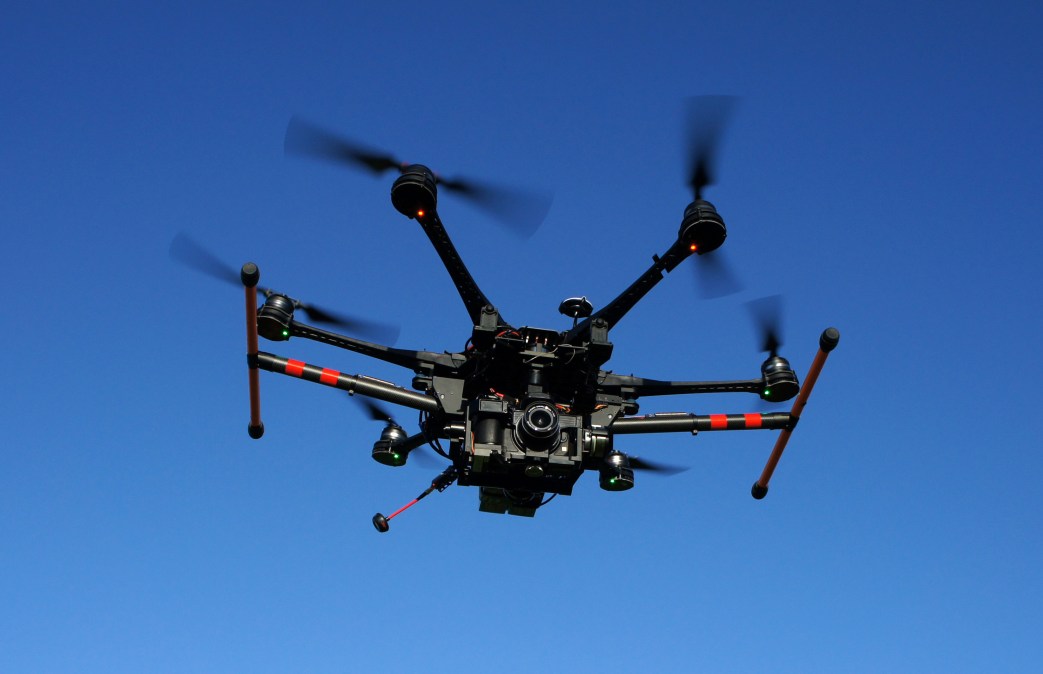
Teams are also keeping a check on their drone defense stockpile.
“When we talk about tech, we’re looking to the skies now,” Szestak said. “UAS, counter-UAS, those are all incredibly important missions.”
Some aspects aren’t controllable. FEMA, for example, is already considering what might happen if resources become constrained due to a hurricane or an earthquake.
“For us, it’s making sure we’re sharing information with everyone,” said Kim Guymon-Lemoult, deputy regional planning branch chief within the FEMA Response Directorate. The team is charting a plan for a potential multi-regional resource adjudication should one be needed.
“It’s getting all that codified beforehand, which is part of planning,” Guymon-Lemoult added.
Whether it’s sharing information internally or externally, or monitoring the skies for drones, technology is at the center. And there’s work to be done, officials from across the agency have emphasized.
Some of the existing gaps
While large-scale events are challenging, there are benefits to securing a pre-scheduled event.
“National security events actually, to me, are more manageable because they’re short, you know they’re coming and you have permission, critically, to do things and get specific waivers that would normally take a long time,” Ryan Riccucci, senior advisor of law enforcement and technology integration at Customs and Border Protection, said at the Red Hat Government Symposium in October.
But even with some time to prepare, there can be hiccups.
“We have two different words for the same thing, two different definitions for the same word across different organizations, missions, systems, vendors and data sets,” Riccucci said on stage.
A threat, a drone, a hostile, a credible threat, or an item of interest could all be used to describe a single unmanned aerial system, for example. In a crowded command center, superfluous alerts cost critical time.
“When you send that to a system, I don’t want 10 dots on the map about a singular drone,” Riccucci said. “And I saw that at FIFA … the reason why there’s nine screens [in a command center] is one screen has the same drone detected three times, and another one only has the singular vendors who can see if it’s three drones or one drone.”
This is still a challenge that agencies are working through.
“Having the software and technology that can basically be the Google Translate for data, that’s what really is missing,” Riccucci said.
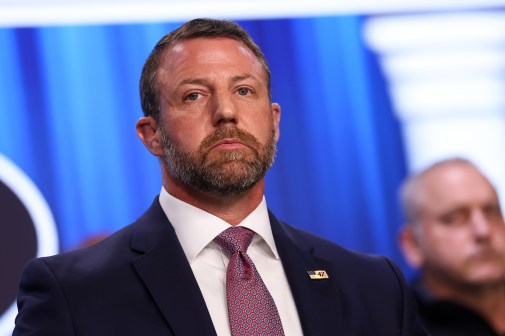
During the Commercial Drone Alliance’s Drone Security Industry and SLTT Grant Forum earlier this month, DHS Secretary Markwayne Mullin said the agency is also looking to improve counter-UAS capabilities in terms of affordability and integrating emerging technologies.
Mullin said one of the attack drones DHS uses carries a production price tag of $40,000. It is a one-way attack drone, designed to crash directly into a target. These kinds of drones are not reusable and have limitations when it comes to mitigating a drone swarm.
“If you think a $40,000 one-way attack drone that only has one use is going to be economically feasible … we’re kidding ourselves to think it is going to work,” Mullin said.
DHS kicked off a $1.5 billion effort to beef up its drone defenses in August, with awards going to Anduril, Booz Allen, GDIT and other major vendors in the space. The investment follows the agency’s creation of a dedicated UAS office and additional funding plans.
Around $250 million is scheduled to go out in fiscal 2027 — as appropriated by the One Big Beautiful Bill Act — to bolster drone detection and mitigation capacity at the state and local levels. But there are questions as the anticipated award date grows closer.
When asked how much money it would require to provide the highest level of drone security for the American public given the forthcoming 2028 Olympics, DHS’s Brian Cavanaugh said: “It’s hard to put a finger on the exact dollar amount.”
“What you have to do is prioritize,” Cavanaugh, who serves as the under secretary for management at DHS, said on stage at the CDA event. “It’s really easy to get bogged down by how broad and how expansive it is. It’s almost like a problem that’s too daunting to tackle.”