Ueland says he wouldn’t be a White House ‘lackey’ as Dems hammer GAO nominee over independence
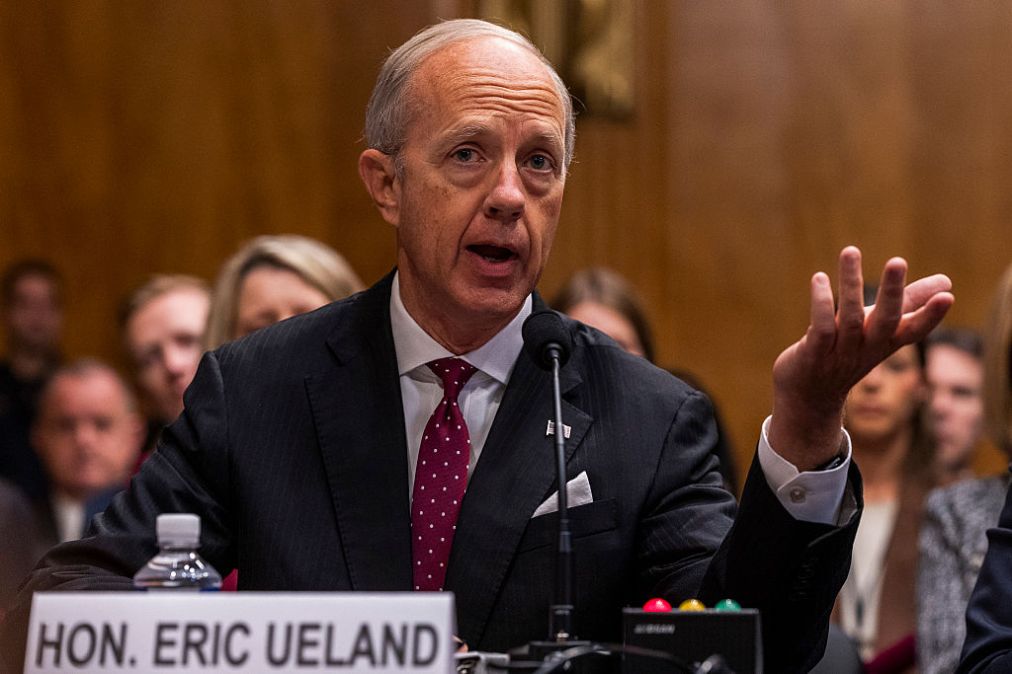
The Republican nominee to lead the nonpartisan Government Accountability Office told lawmakers Thursday that he wouldn’t be a White House “lackey” and that he barely discussed the role with his current boss, who once said the congressional watchdog “shouldn’t exist.”
Eric Ueland tried to convince Democrats on the Senate Homeland Security and Governmental Affairs Committee that he’d be an impartial arbiter as comptroller general of the GAO, despite a rushed, lame-duck process from the White House and his close ties to Office of Management and Budget Director Russell Vought, who also referred to the agency as “a quasi-legislative independent entity.”
Ueland, deputy director for management at OMB and a longtime Senate Republican staffer, said in an exchange with Sen. Maggie Hassan, D-N.H., that he told Vought he wanted to lead the GAO and “that was the extent of the conversation.”
“So let’s take a step back,” Hassan said. “You’ve been nominated to serve as a watchdog over your current boss for an agency that your boss thinks shouldn’t even exist, and now you are claiming to this committee that you only had a single passing conversation with your current boss about your nomination to lead that agency. Is that correct?”
“That is correct,” Ueland replied.
Sen. Gary Peters, ranking member of the committee, hammered Ueland over repeated OMB violations of the Impoundment Control Act, detailed by the GAO in a dozen reports. The Michigan Democrat also took Ueland to task over what he said was OMB’s refusal to cooperate with the GAO on various audits — a common tactic for agencies across the Trump administration.
“How can Congress trust you to run GAO when your agency, which you currently help lead, is absolutely refusing to cooperate with GAO’s oversight?” Peters asked Ueland. “You believe that you’re above the oversight of the GAO, you’re above oversight of Congress. You report directly to the president, do whatever his bidding is, checks and balances be damned. Whatever our founders thought about checks and balances be damned, so that’s what you want to continue?”
“Senator, that’s an incorrect takeaway of what I just said,” Ueland responded.
Democrats were also highly critical of the White House’s process to nominate Ueland for the 15-year term at GAO, which has been led by acting Comptroller General Orice W. Brown since Dec. 30, 2025, following the retirement of Gene Dodaro.
Dodaro, a 52-year veteran of the GAO, ascended to the permanent comptroller general role in 2010 following a year-long bipartisan, bicameral process that included interviews with 13 applicants and ended with his confirmation by unanimous consent.
In an op-ed published in Fortune this week, Dodaro and fellow former Comptroller General Dave Walker wrote that they were “shocked to learn” that HSGAC Chair Rand Paul, R-Ky., “recently and spontaneously requested” that nominees “be submitted to him” instead of through a 10-member statutory committee known as the Comptroller General Selection Commission.
“That Commission is required to jointly develop and transmit a list of at least three qualified nominees to the President,” Dodaro, Walker and Fortune contributing columnist Steve H. Hanke wrote. “That is the law, and that is how the process of appointing the Comptroller General has been conducted since 1980.”
Paul and Sen. James Lankford downplayed those general critiques, though the Oklahoma Republican acknowledged that the “White House seemed to have followed the letter of the law” but he wasn’t “completely sure they followed the entire spirit of the law.”
Early in the hearing, Paul asked Ueland to respond to his “character … being attacked” and to weigh in on whether he would make all decisions as GAO chief “in a nonpartisan way.”
“I understand the responsibilities of the comptroller general, and if I am privileged to be confirmed, I will fully discharge those responsibilities,” Ueland said. “I’m not here as a plant, a stooge, a lackey for anybody. My role and responsibility is to call it as I see it, and that is exactly what I will do if I have the privilege of being confirmed.”
Ueland made the case that his experience with OMB would be a “value add” to GAO. He told Sen. Bernie Moreno, R-Ohio, that he would give the watchdog a “medium” grade for its performance, pointing to 30 open items on its high-risk list.
“That’s a significant challenge in demonstrating efficacy and results for GAO and the federal government writ large,” Ueland said. “We’re responsible at OMB for working with all departments and agencies on their financial management and control system. Our goal inside the administration that I’ve worked on is to deliver a clean audit for the federal government by 2028.”
Paul, Lankford and Moreno were the only Republican senators to question Ueland during Thursday’s hearing, which included a half-dozen other nominees in the first panel alone. But there has been reticence from other GOP lawmakers about Ueland’s nomination, including from Utah’s John Curtis and North Carolina’s Thom Tillis, among others.
In a call with reporters Wednesday, Partnership for Public Service President and CEO Max Stier called Ueland’s nomination “an extraordinary short-circuiting of the process.” Stier said he’s heard that there’s been “surprise in a lot of corners” about how the White House pushed Ueland’s nomination through.
“It’s really important to understand that this is about the Government Accountability Office, which is located in the legislative branch, not the executive branch,” he said. “So we do not believe we’re at the lawsuit point. Where we’re at is the Senate simply saying no to something that is clearly wrong.”