OSTP’s Kratsios denies White House influence over NSF grants decisions
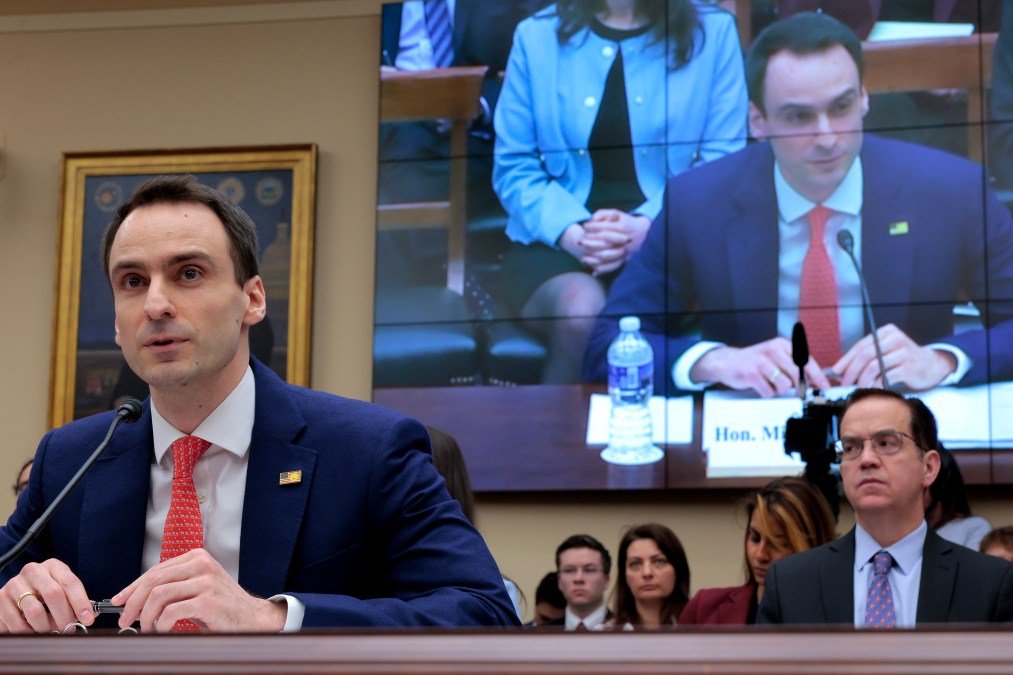
President Donald Trump’s top science and technology advisor told a House science panel Wednesday that the White House isn’t involved in funding decisions at the National Science Foundation as committee Democrats pressed for answers.
In response to questions from Rep. Zoe Lofgren, D-Calif., Office of Science and Technology Policy Director Michael Kratsios said “the White House is not involved in which proposals get funding at” NSF. Rather, Kratsios pointed to the role of OSTP as a conduit for ensuring the president’s science and technology priorities are fulfilled.
But Lofgren, ranking member of the House Committee on Science Space and Technology, and other Democrats on the panel expressed skepticism.
Pointing to recent news reports from Science and Nature, documents obtained by the committee, and confidential sources, the lawmakers posed questions about the White House oversight at NSF and rumors that a portion of its funds are being redirected. Kratsios denied the allegations and remained mum on further details.
The OSTP director’s initial denial of involvement came in response to questions from Lofgren about a document she said committee Democrats received from a source at the agency last week. That image, which was displayed at the hearing, showed a funding opportunity workflow chart with a section labeled “Coordination with DOGE and WH take place outside of workflow.”
“We’ve been hearing rumors for months, and this seems to confirm it that the White House is directly interfering with the operations of the National Science Foundation,” Lofgren said.
Like much of the federal science enterprise, the Trump administration has sought to reshape and scale back funding for NSF. The agency has been without a director since Sethuraman Panchanathan left in April 2025 and began facing grants terminations that the administration said didn’t align with its policies around the same time.
More recently, the Trump administration has proposed overhauls of NSF’s grants process as well as grantmaking across the government — moves that have received pushback from scientists and researchers. Reports have also suggested that funding may be getting directed away from the science agency.
Funding in question
Lofgren asked Kratsios about those reports and specifically a detail that nearly $1 billion in congressional appropriations to NSF is being expropriated from the agency and used for a $1.5 billion project backed by OSTP.
She asked where that funding was, and whether it was part of the nearly $5 billion in commitments related to the Genesis Mission that the White House announced Wednesday morning.
Kratsios said he wasn’t familiar with the details at NSF, and instead highlighted the administration’s desire to direct spending toward “grand challenges.” He pointed to a 122-page Trump administration report published late Tuesday titled “Science: A New Golden Age” that, per the introduction, is a roadmap for science and tech.
That report, among other things, urged fundamental change in the allocation, distribution and assessment of federal research dollars and use of the full federal enterprise to address national challenges.
“I think we as a nation should strive to have these large-scale scientific endeavors that only the government can help marshal the full resources of the nation together to accomplish,” Kratsios said.
Lofgren replied that the committee doesn’t disagree on some of those initiatives — pointing specifically to the bipartisan approval of the National Quantum Initiative Reauthorization Act and support for research into fusion. The concern, she said, is about the scientific enterprise.
Grants slowdown
Meanwhile, Rep. George Whitesides, D-Calif., focused on a reported reduction in grant awards at NSF. Using figures from a project called Grant Witness, Whitesides cited a 55% decrease in the number of grants and a 30% decrease in total grant amounts at NSF between fiscal 2024 to fiscal 2026.
“When awards concentrate into fewer, bigger grants, the researchers who lose out are the … early career applicants in the smaller labs in our research community,” Whitesides said.
He said that contrasts with a remark Kratsios made in his opening statement that he wanted to prioritize young American scientists, and asked the OSTP director to explain what’s going on with grant money.
Kratsios referred Whitesides to NSF but said he would look into it and come back with an answer. After further questions, Kratsios also said the administration is looking to make sure selections are in line with the president’s budget, and indicated interest in seeing those numbers increase.
“To me, I think the pace and the speed at which we do that has to be responsible,” Kratsios said. “And I do see these charts, and nothing would make me happier to make sure that … we are getting closer to where we were in previous years. So, I’ll do everything that I possibly can to help move that line, because I think it’s important for us to get these appropriate dollars out to scientists.”
GOP praise
Kratsios had a warmer welcome from committee Republicans, who praised the administration’s work.
Chairman Brian Babin, R-Texas, suggested that the National Science Foundation’s merit review process, which relies on experts from academia, is biased because faculty lean liberal. He also claimed that federal grants were used to advance DEI initiatives under the Biden administration and promote environmental justice.
He asked Kratsios how the proposed revisions to grants policy would “restore accountability to the American people and elected officials instead of deferring to a political ideology or an unelected bureaucracy.”
Similarly, Rep. Mike Haridopolos, R-Fla., praised the administration’s funding for NASA and Artemis missions, calling it “a great year for science.” He later said he “liked the DOGE idea because it’s how we found so much wasteful spending.”
Remaining questions
But questions still linger among committee Democrats.
In an interview with FedScoop on the sidelines of the hearing, Whitesides said that the director’s responses to his questions contradicted information provided to committee Democrats by “a very reliable source” that grants have been sent to OSTP at some point over the past year for approval.
While Kratsios said the reason why the agency had slowed on grants was because they were aligning with administration priorities, Whitesides pointed to the absence of political officials at the agency.
“Someone’s making decisions,” he said. “Somebody’s doing that. Who’s doing it?”