Trump launches AI-fueled America.gov in bid to tie government services together
The Trump administration unveiled an artificial intelligence chatbot Tuesday that it views as a new front door for services from the federal government.
America.gov, which launched Tuesday morning, opens with a search bar inviting users to ask anything from booking a campsite at a national park, to getting a passport for their child, to replacing their Social Security card. “Whatever you need from the government, start here,” the homepage says.
“Under the hood, America.gov is an extraordinary use of AI designed to improve your life. It’s trained specifically on one official source of truth: The United States Government,” Joe Gebbia, the U.S. Chief Design Officer and co-founder of Airbnb, said during the launch event in Washington, D.C.
According to remarks Gebbia made to CNBC’s Squawk Box on Tuesday, the platform is powered by Google’s Gemini and Elon Musk’s Grok.
The initiative comes as the Trump administration has, generally, sought to increase the use of AI in government and decrease restrictions on the technology. While the government was already implementing the technology before the current Trump administration, AI use has swelled over the past several years.
Programs like the General Services Administration’s OneGov initiative provide AI services to agencies at almost no cost, while programs like USAi provide access to a variety of models at once. America.gov is the latest and most ambitious move to increase the spread of AI-based services across the government.
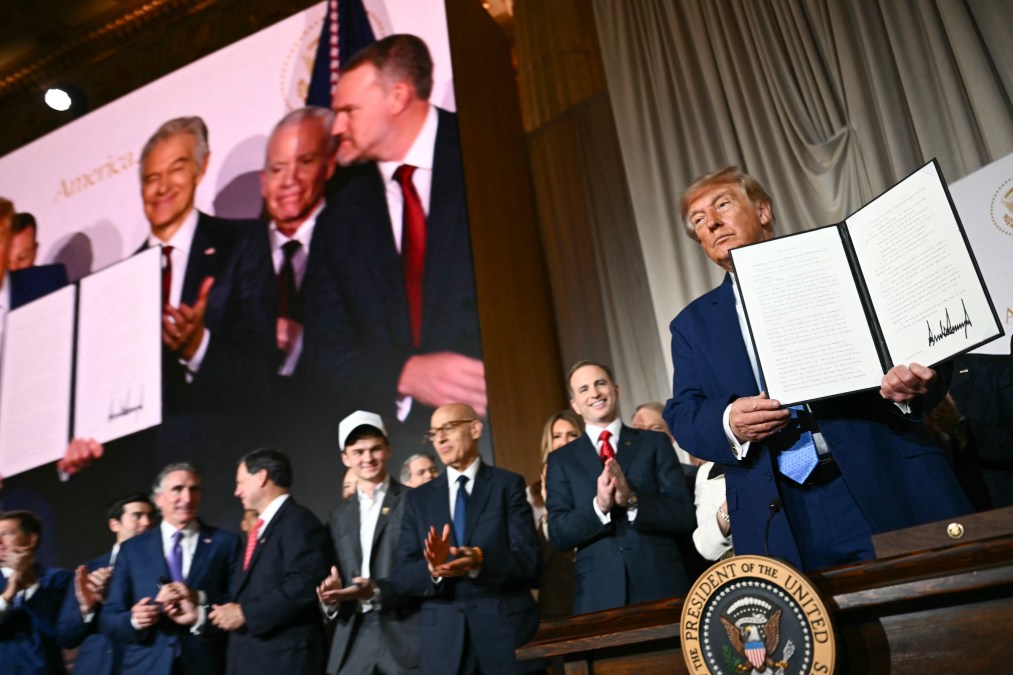
Instead of searching through thousands of government websites, “you’ll now have one front door for every single question,” President Donald Trump said in remarks at the launch event.
According to Trump, the project started “almost on day one” of his administration. He thanked Gebbia, Chief Brand Architect of the U.S. Peter Arnell, and Edward Coristine, the DOGE member known by the name “Big Balls,” for their work on the project. Per Trump, Coristine was the lead engineer on the project.
Notably, Trump thanked Musk, who founded Trump’s controversial DOGE but left before the group saw the end of its mandate. Trump credited Musk with being the person who “initially envisioned the transformation of government through technology and brought us the talent to get the job done.”
Trump signed an executive order on the establishment of America.gov during the event.
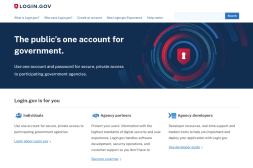
Specifically, that order directed the head of the General Services Administration, the National Design Studio, and the Office of Management and Budget director to establish the platform as “the single point of entry for Americans to access covered services online,” while directing them to integrate Login.gov with that platform.
That follows the administration’s recent direction for agencies to start using Login as an identity verification option wherever possible.
The event, dubbed “Hello, America,” was hosted by the National Design Studio and held in the Andrew W. Mellon Auditorium, just blocks from the White House.
In addition to Gebbia, former White House press secretary Karoline Leavitt and motivational speaker and author Tony Robbins gave introductory remarks, and Centers for Medicare and Medicaid Services Administrator Dr. Mehmet Oz and Secretary of State Marco Rubio gave demos.
Musk and Nvidia CEO Jensen Huang are expected on a panel discussion in the afternoon. A host of Cabinet officials were also in attendance, including Defense Secretary Pete Hegseth and Commerce Secretary Howard Lutnick.
According to the website, the platform is bringing together information from roughly 29,000 government websites. Per Gebbia, updates to government websites will be accessible to the America.gov platform immediately.
The version launched Tuesday, however, isn’t the final product. Currently, the chatbot allows users to ask questions and receive directions on where government services are located, but Gebbia said there are plans come 2027 to allow users to continue processes on the platform itself and track progress.
He gave an example in which a user changing their name after marriage would be able to submit their documents without leaving the platform.
While Gebbia said that the website is “private by design,” there are still unknowns with the new tool. It wasn’t immediately clear how the AI underpinning the platform was procured and how those tools will protect user privacy.
A privacy notice above the chat reminds users to “share only what’s needed,” discloses that it may use approximate location, and states that its “AI providers do not retain your prompts or responses.”
“America.gov may cache responses for up to two hours, using a hash of the prompt rather than storing the prompt text,” that notice continues.
The White House didn’t immediately provide responses to FedScoop’s questions with further detail on how it protects privacy and information about the agreements or contracts pertaining to the technologies it leverages.